
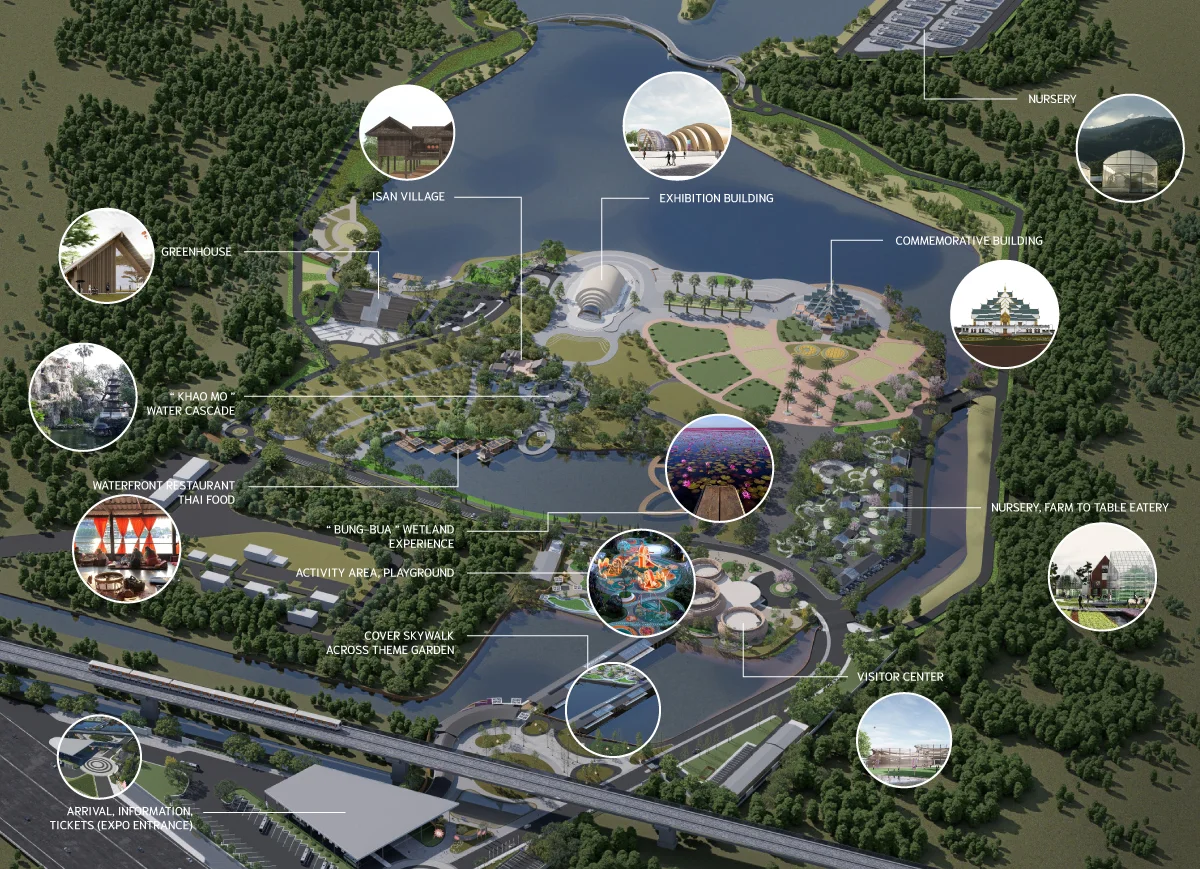
Udon Thani International Horticultural Expo 2026 will take place from 1 November 2026 to 14 March 2027, for a total of 134 days, at Nong Dae Wetland, Kut Sa Subdistrict, Mueang Udon Thani District, Udon Thani Province. It will be the world’s first international horticultural expo to be held on a wetland site.
This guide is designed for visitors planning to attend the Udon Thani International Horticultural Expo 2026, covering everything from what the expo is, where and when it takes place, what to see, ticket prices, how to get there, the best time to visit, where to stay, and what else to explore in Udon Thani. It also clearly identifies information that has not yet been officially announced.
What Is the Udon Thani International Horticultural Expo 2026?
The Udon Thani International Horticultural Expo 2026, or International Horticultural Expo, is an international exhibition showcasing horticulture, plants, gardens, agriculture, innovation, and sustainable development. The event is accredited by the International Association of Horticultural Producers (AIPH), with participating countries creating their own national gardens within the exhibition grounds for visitors to explore over several months.
What makes an international horticultural expo different from a typical flower show is that it goes beyond visual beauty. Each participating garden communicates ideas from its country, including local plant varieties, agricultural knowledge, ways of living in harmony with nature, and technologies designed to address food and environmental challenges. The event also features international horticultural competitions and awards based on AIPH standards, while providing opportunities for international business discussions and cooperation.
Hosting an international horticultural expo is therefore more than simply organizing an event. It gives a city the opportunity to showcase its identity to visitors from around the world throughout the event, while creating a lasting green space for the city after the expo ends.
Why Is the Udon Thani Expo Special?
The Udon Thani International Horticultural Expo 2026 is attracting particular attention for three key reasons:
- The world’s first horticultural expo on a wetland site — Official information states that this is the first international horticultural expo to be held on a wetland site. Wetlands are fragile ecosystems that are not normally used for large-scale events, so the design team has had to incorporate local materials and engineering techniques that preserve the existing wetland environment.
- The first of its kind in the Greater Mekong Subregion (GMS) — No country in the Greater Mekong Subregion has previously hosted an international horticultural expo of this level.
- AIPH Category B accreditation — This accreditation confirms that the event meets international horticultural expo standards rather than being a local event using a similar name.
The main theme of the expo is “The Diversity of Life: Connections of People, Water and Plants Towards Sustainable Living.” The concept is developed around three interconnected pillars. The People pillar focuses on food security and green living. The Water pillar explores smart agriculture and climate change. The Plants pillar focuses on biodiversity, urban agriculture, and vertical farming.
Where Is the Udon Thani International Horticultural Expo 2026?
The Udon Thani International Horticultural Expo 2026 will be held at Nong Dae Wetland, Kut Sa Subdistrict, Mueang Udon Thani District, Udon Thani Province. The expo will be open daily from 1 November 2026 to 14 March 2027, for a total of 134 days. The official opening ceremony and public opening are scheduled to take place on the first day.
Nong Dae is located north of central Udon Thani, close to major transportation routes. It is approximately 15 minutes from Udon Thani International Airport and Udon Thani Railway Station, and around 9 kilometres from the city centre. This makes the site relatively easy to access compared with large-scale events located far outside the city.
The size of the project can sometimes be confusing because two different figures are used. Both are correct, but they refer to different areas. The entire project covers approximately 1,030 rai, or 164.8 hectares, including the existing water and natural wetland areas of Nong Dae. The main exhibition area accessible to visitors covers approximately 484,800 square metres, or around 303 rai.
What Can You See at the Udon Thani International Horticultural Expo 2026?
The exhibition area is divided into six main zones, arranged along the visitor route from the entrance through to the forest area. Each zone offers a different experience, from architectural photography and horticultural displays to agricultural innovation and sustainability.
- Welcome & Ticketing Zone — The starting point of the expo, featuring the main welcome building and a Skywalk crossing the water toward the visitor service centre. It provides visitors with an elevated view of the wetland and creates the first visual impression of the expo.
- International Gardens Zone — The heart of the expo, featuring 17 international garden plots. Each plot ranges from 564 to 1,200 square metres. Some countries will create gardens, while others will combine their gardens with dedicated pavilions. Visitors can experience the atmosphere of multiple countries in one location.
- Greenhouse & Exhibition Buildings Zone — Two exhibition buildings are connected by a central courtyard. The architecture is inspired by vetiver grass, a plant strongly associated with northeastern Thailand. Inside, visitors can discover rare plants requiring different climates, while the buildings also serve as a venue for international horticultural competitions.
- Agricultural Innovation Zone — Showcasing precision agriculture, smart farming, vertical farming, and modern agricultural technologies. This zone is ideal for visitors interested in how agriculture is evolving through technology and innovation.
- Thai Agricultural Gardens & Landmark Buildings Zone — Featuring the Royal Commemoration Building, a landmark inspired by Wat Pa Phu Kon, together with an Isan village recreating traditional local houses such as Huen Koei, Huen Kho, and Huen Fai. The area showcases local art, culture, traditional lifestyles, and local food.
- Sustainable Forest & Nursery Zone — Featuring a carbon-credit forest and educational areas dedicated to sustainable forest management, together with the plant nursery used to grow and maintain plants for the expo.
Throughout the 134-day event, visitors can also enjoy rotating activities including horticultural competitions based on AIPH standards, Isan cultural performances in the Isan Village, agricultural conferences, and National Days organized by participating countries, with each country presenting special activities on its designated day.
Udon Thani International Horticultural Expo 2026 Ticket Prices
As of 25 August 2026, official ticket prices for the Udon Thani International Horticultural Expo 2026 have not yet been announced. Hotelmoco.com will update this information once official details become available.
How to Get to the Expo, Parking & Visitor Facilities
The expo site is approximately 9 kilometres from central Udon Thani, taking around 16 minutes by car. It is also approximately 15 minutes from Udon Thani International Airport and Udon Thani Railway Station. Visitors will have several transportation options, including driving, free shuttle buses from locations around the city, and a railway service planned to stop directly at the expo site.
Distances from Key Locations in Udon Thani
| Starting Point | Approx. Distance | Driving Time |
| UD TOWN | 9 km | Approx. 15 minutes |
| Thung Si Muang | 8.2 km | Approx. 15 minutes |
| Udon Thani Premium Outlet | 8 km | Approx. 10 minutes |
| Makro Udon Thani 2 / Go Wholesale | 6–8 km | Approx. 8 minutes |
| Udon Thani International Airport | 13.7 km | Approx. 15 minutes |
| Udon Thani Railway Station | 9 km | Approx. 15 minutes |
Free Shuttle Buses & Pickup Points in the City
Udon Thani is preparing a free shuttle bus system connecting the city with the expo site. Reports indicate that the service will use approximately 30 buses operating across 25 routes, with 50 to 100 trips per day and capacity for around 13,000 passengers per day. A real-time traffic management system is also planned to help distribute buses according to passenger demand.
Seven pickup locations have been published, including UD TOWN, Thung Si Muang, Udon Thani Premium Outlet, Makro Udon Thani 2, Go Wholesale, and two Bangchak stations: one on Mittraphap Road inbound from Nong Khai and another on the Sakon Nakhon route.
How to Travel from Bangkok to the Udon Thani International Horticultural Expo 2026
Udon Thani can be reached by several modes of transportation, with each option suited to a different type of trip.
- By Air — Flying is the fastest option. Flights from Don Mueang or Suvarnabhumi Airport to Udon Thani take approximately one hour, followed by another 15-minute journey to the expo site. This is ideal for visitors planning a short two- to three-day trip. During the expo period, flight frequencies are expected to increase by approximately 20–30% from the normal schedule of around 40 flights per day.
- By Train — The Bangkok–Nong Khai railway line already passes through Udon Thani. A temporary railway station named “Nong Dae Public Park” is being constructed next to the expo site. The platform will be approximately 150 metres long, with a covered roof and lighting. Completion is expected in September 2026. If the station opens as planned, visitors will be able to get off the train and walk directly into the expo.
- By Bus — The Transport Co. is preparing a package called “Travel Comfortably to the Horticultural Expo” in cooperation with TCEB, with connecting routes through Khon Kaen for visitors who would like to stop and explore along the way.
- By Private Car — Drivers can use Mittraphap Road, Highway 2, and enter via the Nong Dae intersection. The province has upgraded Rural Road Udon Thani 3090 over a distance of approximately 9.5 kilometres and added three traffic-light intersections to accommodate increased traffic and large buses during the expo.
Parking & Park-and-Ride Facilities
Parking within the expo area is reportedly expected to accommodate more than 5,000 vehicles per day. Additional park-and-ride facilities are planned outside the main site, including locations in Nong Samrong Municipality and around Labour Hall Region 4, where visitors can leave their cars and continue by shuttle bus.
Visitors should be aware that parking may reach capacity during long weekends and public holidays, particularly from late morning onward. Traffic may also become heavy when large numbers of visitors leave the expo at the same time in the evening. A more convenient option may be to stay in the city and use the free shuttle service, avoiding the need to search for parking or deal with heavy traffic after the event.
Visitor Facilities at the Expo
The organizers have confirmed that the expo site will provide first-aid stations, a central tourist information centre, lost-and-found services, security services, lighting throughout the site, and public-area cleaning and maintenance. There are also reports of four medical stations and more than 1,000 trained staff and guides. Youth guides will also be available with communication skills in English, Chinese, and Lao.
Hotels, Restaurants & Other Services in Central Udon Thani
Planning accommodation, meals, and transportation is an important part of visiting the Udon Thani International Horticultural Expo 2026. Central Udon Thani offers convenient accommodation, dining, shopping, and transportation options for expo visitors.
Hotel MOCO Udon Thani
Hotel MOCO Udon Thani is located in the heart of the city, next to UD TOWN, one of the designated shuttle pickup points for the Udon Thani International Horticultural Expo 2026. It is also close to Montatip Hall.
This location is particularly convenient for two groups: travellers arriving by air or train without a private vehicle, and corporate groups combining meetings with a visit to the expo.
Guests can leave their cars at the hotel and use the free expo shuttle service to travel from UD TOWN to the exhibition site.
Restaurants & Places to Eat Before or After the Expo
Food and beverage outlets will be available inside the expo in the Isan Village zone, focusing on local cuisine. However, the complete list of vendors has not yet been announced. Many visitors may therefore prefer to have their main meal in the city before heading to the expo in the morning or after returning in the evening. UD TOWN is particularly convenient because it combines a shuttle pickup point with a wide range of restaurants.
- Par Restaurant — The signature restaurant at Hotel MOCO, ideal for lunch before heading to the expo or a relaxed dinner after a full day of walking. The restaurant serves Thai-Western cuisine and Isan-inspired fusion dishes. Reserve a Table
- Brunch & Munch — Serving Western-style dishes, all-day brunch and breakfast, together with tea and coffee. Located at The Next, Soi 5, inside UD TOWN.
- Thong Yai Noodle — A local noodle restaurant offering a variety of noodles, including wide rice noodles, thin rice noodles, flat rice vermicelli, egg noodles, and charcoal noodles, together with popular snacks and local favourites. Located inside UD TOWN Soi 5, next to Thailand Post.
Visiting as a Group, Organization or Study Tour
For organizations looking for an annual meeting or off-site destination outside Bangkok, Udon Thani offers several advantages. Flights from Bangkok take less than an hour, the city has major conference facilities and hotels, and an international event such as the Udon Thani International Horticultural Expo 2026 will take place in the same city. Organizations can hold a meeting in the morning and take their team to the expo in the afternoon.
- Meeting & Conference Facilities — Montatip Hall is a major convention and event venue in central Udon Thani, accommodating everything from smaller groups to large-scale conferences.
- Group Accommodation — Hotel MOCO is located in the same area and within convenient reach of the expo shuttle pickup point.
- Group Tickets — Groups of 15 or more are eligible for reduced per-person rates, starting at THB 270 for organizations and THB 135 for educational institutions.
- Extend the Trip into a Study Tour — The Agricultural Innovation Zone and Sustainable Forest Zone are particularly suitable for agricultural organizations, educational institutions, and companies working in sustainability.
UD TOWN — The Heart of Central Udon Thani
UD TOWN is a major shopping and lifestyle destination in central Udon Thani. During the Udon Thani International Horticultural Expo 2026, it will also serve as a shuttle pickup point, meeting point, dining destination, and place to shop for local souvenirs.
For visitors who have free time after the expo, UD TOWN is an easy place to end the day, with restaurants, shops, and souvenirs all in one location before returning to the hotel.
What Else to See in Udon Thani After the Horticultural Expo
Udon Thani is home to two UNESCO World Heritage Sites, as well as natural and cultural attractions that can easily be added to an expo trip. With good planning, visitors can spend half a day at the Udon Thani International Horticultural Expo 2026 and visit another attraction on the same day.
- Red Lotus Lake (Nong Han, Kumphawapi) — Approximately 45 kilometres from central Udon Thani. Visitors should plan to arrive early in the morning, when the lotus flowers are at their best, typically between 6:00 AM and 9:00 AM. Peak blooming season is from December to February, which coincides with the middle of the horticultural expo.
- Ban Chiang Archaeological Site — A UNESCO World Heritage cultural site approximately 50 kilometres from the city centre. Allow around two to three hours for a visit.
- Phu Phrabat Historical Park — Another UNESCO World Heritage Site in Udon Thani, approximately 65 kilometres from the city. Allow around half a day to explore the ancient rock formations and prehistoric paintings.
- Kham Chanot — Approximately 70 kilometres from central Udon Thani. A popular spiritual destination that many visitors to the province choose to visit.
- Wat Pa Phu Kon — Approximately 100 kilometres from Udon Thani. Allow around half a day. The temple also inspired the design of one of the landmark buildings at the horticultural expo.
- Nong Prajak Public Park — Located within Udon Thani city, this is ideal for a relaxed morning or evening visit. Allow approximately one to two hours.